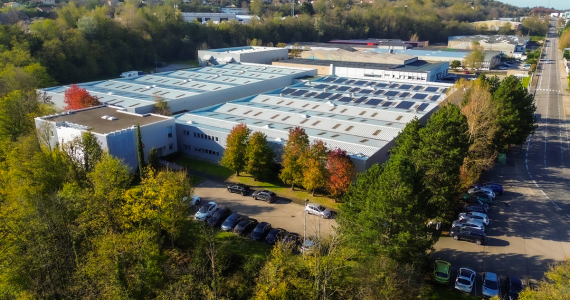
The strap: an essential component in a vehicle’s interior
In a rapidly changing automotive market, where optimising interior space and reducing the weight of structures are becoming strategic priorities, every component counts. Whether it is securing the load in a commercial vehicle or incorporating smart storage solutions, the technical strap is much more than just an accessory: it is a key element of safety and comfort.
As a leading webbing manufacturer, Eurosandow supports car manufacturers and Tier 1 suppliers in the design of high-performance textile solutions. Thanks to our expertise in weaving, we transform complex specifications into finished products woven webbing, braided webbing or rigid webbing – that meet the most stringent standards.
Versatile applications for every area of the vehicle
The interior layout of a vehicle requires components capable of adapting to a variety of configurations whilst ensuring unfailing reliability. Our straps are designed to address three key challenges: the ergonomics of the passenger compartment, the modularity of the spaces and the security of moving parts.
In both passenger cars and commercial fleets, optimising space is now essential. Drivers today favour cars with clean lines, offering plenty of storage and ample space.
The integration of technical straps can, for example, provide an alternative to nets or bulky, rigid storage solutions.
Securing straps
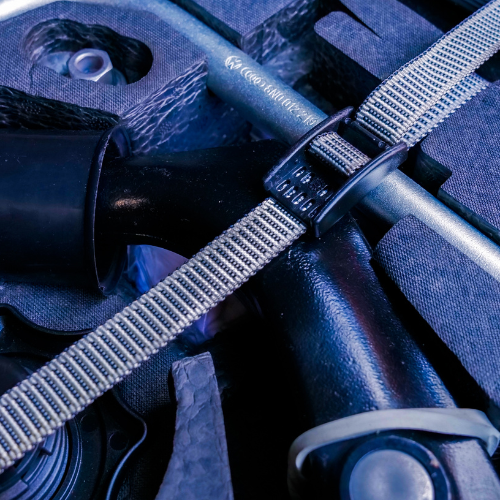
In the boot of city cars, SUVs and utility vehicles alike, straps remain a simple and effective way of securing loads. These securing straps can be attached to the side panels of the boot to store jerry cans, windscreen washer fluid, oil or other maintenance equipment.
Underneath the boot floor, straps are also used to secure the spare wheel, the space-saver spare and the emergency kit.
This type of strap can also be used to store and secure charging cables for electric vehicles (EVs).
Lashing straps remain the ideal solution for securing items: their fabric texture protects components from damage, with no risk of scratches or movement whilst driving.
The strap is a flexible component that adapts to all configurations and integrates easily into the assembly lines of equipment manufacturers and car manufacturers.
Finally, unlike rigid fastenings, our textile straps absorb vibrations, thereby eliminating unwanted noise whilst driving.
Restraint straps
Restraint straps are essential for ensuring passenger safety. These components must meet extremely high strength requirements to guide the deployment of the airbag in a fraction of a second.
These straps must be capable of withstanding the force exerted by the airbag upon deployment, whilst ensuring that the airbag remains perfectly positioned to protect the occupant. For this type of application, we select state-of-the-art materials to design polyamide or Kevlar straps.
In more everyday applications, our straps are also used to limit the travel of boot lids or to secure the opening of storage compartments.
Seat manoeuvring strap
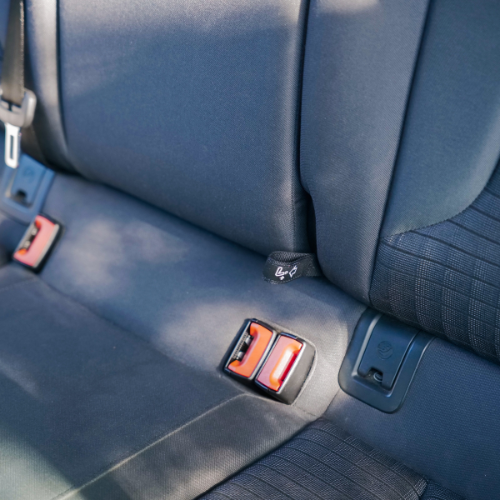
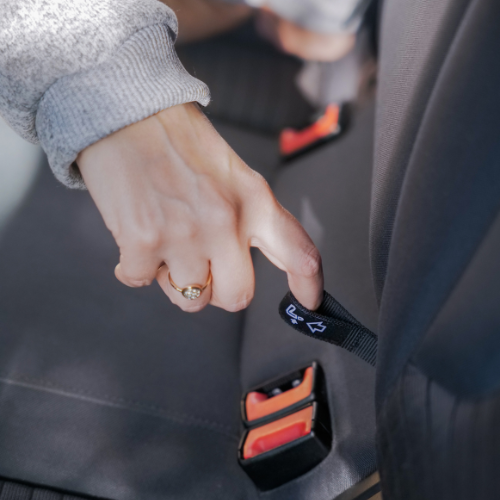
One of the key factors in the comfort of a vehicle’s interior is the modularity of its features. Drivers and passengers must be able to easily adjust their seats to create space and ensure a smooth driving experience. This is where the car seat strap plays a crucial role.
Although discreet, these adjustment straps play an essential role in this modularity. They make it easier to recline the seats, particularly the rear bench seat, to maximise boot space.
These straps are sometimes marked with an intuitive icon using thermal transfer printing, which guides the user without them having to think about it.
Upholstery straps
Although concealed beneath the textiles, leather or foam in the passenger compartment, upholstery straps are key to the perceived quality of a vehicle’s seats.
The challenge is to ensure that the upholstery does not sag or crease over time.
Upholstery straps are usually woven. They help to keep the padding in place and ensure a comfortable ride for drivers and passengers.
Handle straps
For door handles on ‘sport’ models, the strap provides a robust yet ultra-lightweight pulling solution. Manufacturers use this alternative to remove as many plastic components as possible and reduce the vehicle’s weight in order to optimise its performance.
Handle straps are also used in the boot of a car or van to lift the false floor. This makes it easier to access the spare wheel.
Tubular straps for seat cover tensioning
The visual appearance of the seats is the key factor in how quality is perceived when getting into a vehicle. To ensure that the leather or fabric remains perfectly taut, even after years of use, we manufacture tubular straps for seat cover tensioning. Their role is to maintain constant tension between the upholstery and the seat frame. Unlike conventional flat straps, the tubular structure offers superior flexibility and better force distribution, allowing the seat cover to return to its original shape.
What criteria should you consider when choosing a vehicle strap?
Choosing a strap for a car’s interior is about more than just selecting a width or a colour. It’s about finding the right balance between durability, elasticity and strength.
Choice of materials
Synthetic fibres
Polyester webbing (PES)
This is the most widely used fibre in the automotive industry. Why? Because it is extremely stable. It offers excellent resistance to UV light (behind windows) and does not stretch over time. It is the ideal choice for lashing straps or airbag retention straps where precision is vital. Available in 20 mm, 25 mm, 30 mm, 40 mm and 50 mm polyester webbing.
Polyamide (PA / Nylon) Strap
Polyamide is unbeatable in terms of tensile strength and abrasion resistance. More elastic than polyester, it is capable of absorbing significant impacts without breaking. It is often used for components subjected to repeated friction or dynamic stresses.
Polypropylene (PP) Strap
This is the lightest material. It is ideal for applications where the strap is hidden from view or subject to low mechanical stress, such as padding straps. It offers excellent resistance to chemicals, is unaffected by moisture and helps to optimise costs for large production runs. We can produce a wide range to suit your needs: 10 mm, 15 mm, 20 mm, 25 mm, 30 mm, 40 mm and 50 mm polypropylene straps.
Polyethylene (PE) Strap
Although less commonly used as a pure strap material, it is nevertheless very useful due to its ‘slip’ properties and exceptional resistance to chemicals. It is often used in specific technical environments where the strap must not catch on surrounding surfaces.
Aramid (Kevlar®) Strap
For areas subject to very high temperatures or requiring cut resistance, aramid is the solution. It is a fibre that does not stretch at all. It is used for safety-critical components or in the immediate vicinity of areas of intense heat.
Natural Fibres
The car of the future is set to be more sustainable. That is why we incorporate natural fibres to help you meet your Corporate Social Responsibility (CSR) and eco-design objectives.
Linen webbing
Linen is increasingly favoured by manufacturers for its bio-based properties. Technically, it offers excellent rigidity and very good vibration absorption. It is a fibre that adds a ‘natural premium’ touch to the cabin, whilst delivering high mechanical performance.
Cotton webbing
Cotton is favoured for its soft, matt appearance. In a vehicle interior, it is used for comfort webbing or interior trim elements where contact with the skin must be pleasant. It is often blended with synthetic fibres to increase strength whilst retaining its warm appearance.
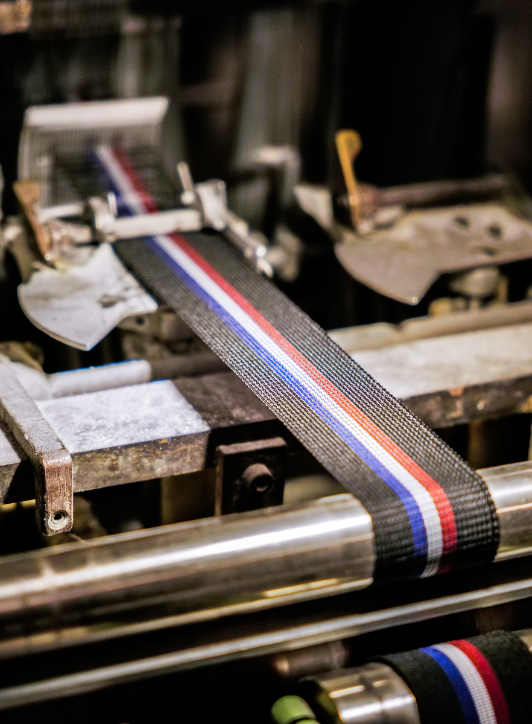
Choosing the right size
The choice of strap size will depend on its intended use:
Narrow straps (10 to 25 mm)
Ideal for interior trim, headrest trim or small storage pocket fastenings. They are discreet and slot easily into seat structures without adding bulk.
Wide straps (30 to 50 mm and above)
Intended solely for securing heavy loads (spare tyres, batteries) or as carrying handles. A greater width helps to distribute the pressure more evenly across the object being secured, thereby preventing it from being marked or damaged.
What finishing treatments should be carried out on the straps?
Ultrasonic cutting
Thermo-fixing
Branding and design
This process enables drilling of all shapes, welding and cutting on a variety of materials. This technique produces a clean cut with no fraying.
The webbing is heated to a controlled temperature whilst being kept under constant tension. Depending on the requirements of your specifications, we can also incorporate chemical additives during this phase. This heat treatment alters the internal structure of the fibres to tailor their performance to the end use.
This process tightens the fibres and smooths the surface of the webbing. It becomes more robust against repeated friction
Heat-setting gives the webbing a neat, polished and glossy finish. It does not fray and retains its appearance over time.
We can add UV-resistant and water-repellent treatments. The webbing does more than just hold; it protects and complies with the strictest safety standards.
Logos or icons are printed on them for ease of use, and there is a wide range of colours to choose from to ensure they blend in perfectly with the interior design.
Why choose Eurosandow as your partner for your projects?
In an industry where precision and reliability are key, choosing a supplier is about more than simply ordering a product from a catalogue. It’s about working with a partner who can understand your production constraints and adapt to them. Here’s what makes Eurosandow the preferred partner for manufacturers and equipment suppliers.
From prototype to mass production: expert responsiveness
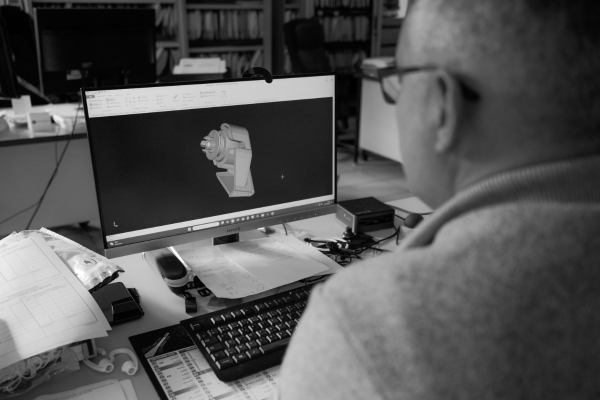
We know that your development cycles are intense. That is why we have structured our manufacturing facilities to support you right from the design phase. Our technicians work from your drawings to produce rapid prototypes, enabling you to validate the integration of the straps directly into your cabin mock-ups. Once the product has been approved, we move into mass production with consistent rigour, whether you need a few hundred or tens of thousands of units.
Encouraging short supply chains
To meet the demands of the automotive supply chain,
Eurosandow benefits from a strategic geographical location with two production sites:
Our factory in France (Saint-Étienne): A long-standing centre of expertise and innovation, it ensures maximum responsiveness for your projects in Western Europe and complete control over R&D.
Our factory in Romania: Located at the heart of a major automotive industrial hub, it enables us to serve assembly plants in Central and Eastern Europe with great efficiency.