

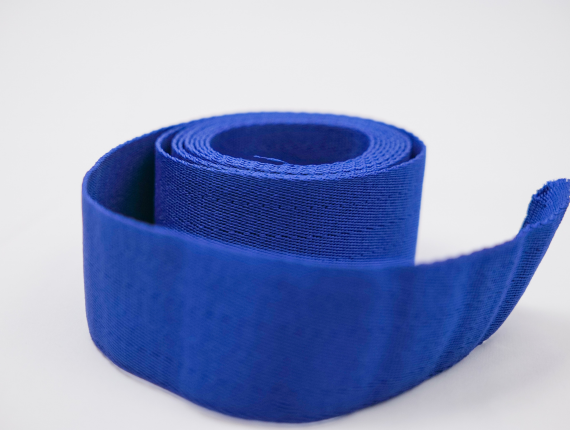
Cotton webbing refers to webbing woven from a natural cellulose fibre extracted from the seed of the cotton plant. Unlike polyester or polypropylene, it is not derived from petrochemicals: its fibrous structure and mechanical properties differ significantly from those of synthetic technical textiles.
A cotton strap absorbs moisture, is gentle on surfaces and produces no noise when rubbed. Its resistance to abrasion and heat is modest, and its breaking strength is lower than that of synthetic fibres. It is therefore a material used for contact and aesthetic purposes, and its scope of use must be precisely defined.
This page sets out its properties, criterion by criterion, to complement our guide to straps: which material should you choose?
The technical properties of the cotton webbing
First, a word about the fibre itself. Cotton is a plant fibre extracted from the seed of the cotton plant, consisting mainly of cellulose (around 90 per cent in raw fibre, and even more after washing and bleaching). It has a distinctive structure: a flat ribbon twisted upon itself, with a hollow centre. This natural twist and internal cavity account for both the strap’s flexibility and its absorbency.
A second key difference from synthetic fibres, which is crucial for a webbing strap: cotton is a short fibre, spun into staple fibre, whereas polyester and polyamide are extruded into continuous filaments. A spun yarn has a slightly fuzzy surface and lower tenacity for an equivalent structure, which is directly reflected in the abrasion and breaking strength scores below.
| Criteria | Level |
|---|---|
| Tensile strength | Suitable (3/5) |
| Heat resistance | Not very suitable (2/5) |
| Abrasion resistance | Not very suitable (2/5) |
| Sun exposure (UV) | Suitable (3/5) |
| Moisture resistance | Perfectly suited (5/5) |
| Flexibility (density) | Perfectly suited (5/5) |
| Buoyancy | No |
| Storage in a damp environment | Not very suitable (2/5) |
Two rows in this table warrant careful consideration, as they appear to be contradictory. Cotton achieves the highest possible score for moisture resistance, on a par with polyester or polyamide: the fibre retains its properties even when wet. Its ranking drops, however, when it comes to storage in a damp environment, for one simple reason. Cotton absorbs and retains water, which encourages mould and stains when stock is left undisturbed for several months. A cotton webbing strap therefore withstands moisture whilst in use, but must be stored in a dry place.
In terms of thermal properties, the fibre is flammable and decomposes at around 160 °C, without undergoing a melting phase as synthetic materials do. Its flexibility is rated at the highest level, on a par with linen and aramid. The two identified chemical sensitivities are sulphuric acid and 80 per cent cupro-ammoniacal solution. Cotton does not float.
The benefits of cotton webbing
Great flexibility: Cotton scores top marks in this category, on a par with linen and aramid. A cotton strap hangs naturally, moulds to the shape of the garment, does not retain any pronounced creases and can be sewn without any particular difficulty. On a garment that is frequently handled or visible, the difference compared to a stiff synthetic strap is immediately apparent.
Comfort : Soft to the touch, no abrasive feel, and good moisture-wicking properties: the hollow fibre absorbs moisture rather than allowing it to form a film on the surface. Cotton also scores top marks for moisture resistance, as the fibre retains its properties even when wet. This is what makes it the material of choice for garments in prolonged contact with the skin. Added to this is its natural resistance to static electricity, which is particularly beneficial in linings and outerwear.
A look that synthetic fabrics struggle to replicate: cotton takes on deep, matt hues, and its natural texture is apparent both to the eye and to the touch. Whether on furniture, packaging or leather goods, this is often the deciding factor.
Technical limitations to be aware of
Abrasion resistance: This is its main weakness. Spun yarn has a fuzzy surface that wears away quickly when subjected to friction. A cotton webbing strap is therefore unsuitable for use in a pulley, in a loop under tension, or where it comes into repeated contact with a metal edge.
Load-bearing capacity: Polyester, polyamide, polyethylene and aramid perform better, and even flax exceeds it. The direct consequence is that cotton webbing must not be used for lashing, lifting, slinging or personal protective equipment. The material is reserved for moderate, static loads.
Heat and fire resistance: The fibre is flammable and decomposes at around 160 °C. Unless treated with a flame retardant, it must not be used in fire-risk environments or in areas close to a heat source.
Storage in damp conditions: A stock of cotton webbing kept in a damp room becomes stained, develops mould and takes on odours. A dry storage area and batch rotation become real logistical challenges.
Dimensional stability: Cotton absorbs moisture from the air, causing the yarn to swell slightly and the strap’s dimensions to vary. Untreated straps are also likely to shrink during the first wash; this should be taken into account when calculating the cutting lengths.
Lack of buoyancy: Cotton sinks. For marine applications where the webbing needs to remain on the surface, polypropylene or polyethylene are the obvious choices.
Cotton, polyester or polypropylene: how the material makes a difference
| Criteria | Cotton | Polyester | Polypropylene |
| Tensile strength | Suitable | Very suitable | Suitable |
| Abrasion resistance | Not particularly suitable | Very suitable | Not suitable |
| Heat resistance | Not particularly suitable | Suitable | Not particularly suitable |
| Flexibility | Perfectly suited | Very suitable | Suitable |
| Moisture resistance | Perfectly suited | Perfectly suited | Suitable |
The choice depends on the level of mechanical stress. Whenever a load needs to be borne, the strap needs to withstand prolonged friction, or it is to be used outdoors for extended periods, the polyester strap [link to: URL for related polyester page] outperforms the cotton strap across all mechanical criteria. For less demanding applications where budget is a constraint, polypropylene webbing [link to: polypropylene sister page URL] is a viable alternative, provided one is prepared to accept its lower abrasion resistance.
25 mm, 30 mm or 40 mm cotton webbing: widths and packaging options
Three widths cover the vast majority of requirements. The 25 mm cotton webbing is used for delicate items and accessories, where discretion is key. The 30 mm cotton webbing remains the most popular, particularly for bag straps, handles and interior fittings. The 40 mm cotton webbing is suitable for moderate loads and padding, where the load needs to be distributed over a wider surface area.
Our straps are available in widths ranging from 10 to 50 mm. The packaging can be tailored to your production process: in 100-metre reels or cut to length for finished products. . Sewn trims, buckles and accessories can be fitted on request.
Have your custom-made cotton strap made
Working with a manufacturer specialising in integrated cotton webbing opens up three design options: yarn count, construction (weaving, braiding, knitting, Jacquard) and colour.
Our workshops in Saint-Étienne carry out all of these processes, supported by a design office which analyses your specifications prior to development.
We are able to produce both large volumes and small batches, depending on your requirements.
Frequently Asked Questions
Is the cotton strap moisture-resistant?
It performs quite well when used for a short period, but less so when stored damp for a prolonged period. Over time, cotton stored whilst damp will develop mould and odours. For permanent outdoor use, a polyester strap is preferable.
What width of cotton strap should I choose?
The most popular sizes are the 25 mm cotton webbing, the 30 mm cotton webbing and the 40 mm cotton webbing. Other widths are available on request, subject to a quote, depending on your project.
Is the cotton strap suitable for heavy loads?
Not ideal. Its abrasion resistance and heat behaviour (it breaks down at around 160°C without melting) mean it is only suitable for moderate use. For heavy-duty lashing, a polyester or polyamide strap offers better mechanical strength.