As the centrepiece of a vehicle’s interior, both the driver’s seat and the passenger seats have evolved significantly over the years. Today, a car seat is a complex piece of equipment incorporating electronics, active safety features and increasingly sophisticated comfort adjustments.
The comfort of a car seat does not depend solely on the foam or upholstery: it depends on the invisible, constant tension that holds each component in place. Automotive elastic tensioners and technical cords ensure this perfect fit.
As an expert in the manufacture of industrial textile solutions, Eurosandow designs bespoke elastic cords and straps that meet the requirements of car manufacturers and Tier 1 suppliers.
Car seat cords, essential components in the passenger compartment
When designing a seat, the elastic tensioner is not merely a fastening accessory. It helps to support the structure and ensure a comfortable ride for the driver and passengers
The stringing cords
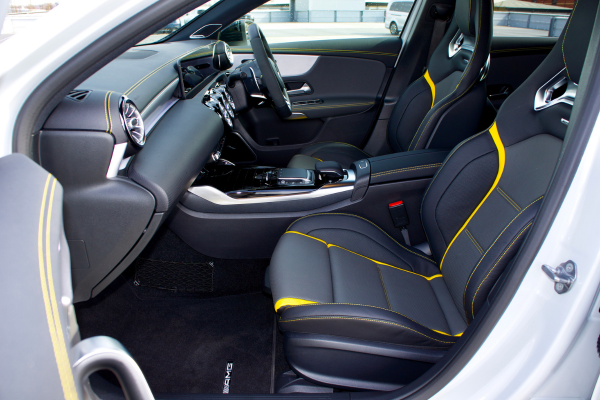
Whilst the design of a car seat is its visual signature, the lacing cord is its invisible skeleton. This technical component is essential for transforming a flat cover into an ergonomic and aesthetically pleasing seat, capable of sculpting the seat’s contours.
Creating contours and structuring the seat
The primary function of the lacing cord is to press the cover (fabric, leather or Alcantara) precisely against the seat foam. By following predefined tension lines, it creates:
The aesthetic design: the contours and stylised lines that define the seat and backrest.
Lateral support: By accentuating the contours on the sides (the side bolsters), it provides support for the passenger, ensuring they do not slide around on bends.
Choosing a high-performance cord is essential for the vehicle’s lifespan. Careful lacing helps to avoid three major problems:
Visual defects: Poor stitching or uneven tension creates unsightly creases or a ‘bulging’ appearance, which detracts from the perceived quality of the vehicle.
Ergonomic instability: The lacing prevents the fabric from moving or slipping beneath the driver’s body, ensuring a stable driving position.
Sagging: By maintaining constant tension, our tension cords prevent the seat cover from sagging prematurely over time, keeping the seat looking as good as new even after years of use.
Tension cords and fastenings for nets
Tension, elasticity and modularity
Elastic cords can be used to fit storage accessories such as nets. They ensure that storage nets remain taut over time, preventing them from sagging, which looks unsightly.
Whether it is a backrest net or a centre console net, the tension cord must exert sufficient pressure to hold heavy items (tablets, bottles of water) securely in place without slackening.
A poor-quality cord will eventually ‘sag’. Our solutions are designed to retain their shape memory, ensuring that the net always returns to its original position, flush against the seat, when empty.
Design and customisation
As every car seat and interior design is unique, we offer a fully customisable range of net fastening cords.
The sheathing can be solution-dyed to match the colour of the upholstery or stitching perfectly, enhancing the visual harmony of the interior.
Project example :
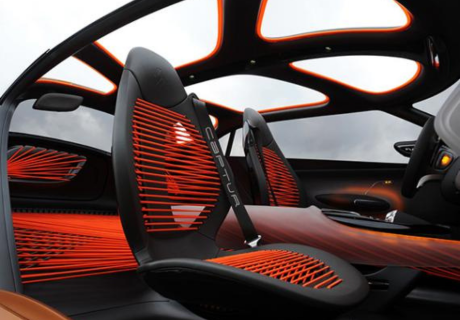
Eurosandow worked with Renault to create the iconic pouch for the first Captur. For this model, traditional storage was replaced by a set of colourful elastic drawstrings attached directly to the backs of the front seats. This solution, which was both striking and bold, allowed the colour of the drawstrings to be perfectly matched to the upholstery and the vehicle’s finish, creating a unique interior design.
End fittings and fastenings
The performance of a seat net cord depends not only on its elasticity, but also on the reliability of its anchoring. To ensure quick and secure installation on your assembly lines, Eurosandow has developed a comprehensive range of bespoke fastenings and end fittings:
➡️ Plastic-coated steel hooks
➡️ Overmoulded hooks
➡️ Swivel end caps
➡️ Carabiner hooks
These hooks are used in particular to secure wrap-around nets and boot floor nets. Designed to fit perfectly into the anchor points located on the rear seat backs or side panels, they ensure optimum load security.
Whether you’re securing bulky items at the back of the boot or dividing the space with a vertical net (envelope-style), our systems ensure constant tension.
Materials: strength, elasticity
The choice of components for an elastic cord or a tensioner leaves nothing to chance. Inside the passenger compartment, materials are subjected to stress and repeated cycles of use. In the automotive sector, the core (latex, EPDM, etc.) provides the mechanical function (the spring), whilst the outer sheath (often made of polyester or nylon) provides protection against cuts and limits maximum elongation to prevent the core from breaking.
1. The elastic core
This is the heart of the rope. The choice of material for the core can influence the rope’s elongation characteristics.
Natural latex (rubber)
This is the ‘traditional’ and most common material used for high-quality bungee cords.
Why choose it: It has exceptional elasticity (up to 600–700 per cent) and excellent ‘memory’ (it returns to its original shape without losing its form)
Fulflex
Fulflex is a brand specialising in rubber cords (often made from synthetic or natural polyisoprene).
Why choose it: It guarantees perfect uniformity in diameter and tension. Unlike raw latex, it is treated to be more resistant to chemical ageing.
Elastane (Spandex / Lycra)
This is a synthetic fibre known for its fineness.
Why choose it: It is used when a very fine, lightweight cord is required, or when you want to incorporate elasticity directly into the braiding of a cord rather than using a solid core.
Elastomers (TPE/TPU)
These are synthetic polymers that can be worked like plastic but are as elastic as rubber.
Why choose them: They are recyclable and extremely resistant to chemicals and abrasion. Their hardness can be precisely adjusted during manufacture.
EPDM (Ethylene-Propylene-Diene Monomer)
Why choose it: Its resistance to heat, ozone and the elements is unrivalled. It does not crack in the sun and withstands temperature fluctuations.
2. The sheath
If the core is the ‘muscle’ of the rope, the sheath is its ‘skin’. It plays a crucial role: it protects the core from abrasion, sets the limit on elongation and enables the rope to withstand its environment (heat, chemicals, friction).
Standard polymers
Engineering polymers
Innovative materials
These include materials such as polyethylene (PE), polypropylene (PP) and polyester. This type of material offers good strength for standard applications.
Materials such as polyamide offer excellent abrasion resistance. It is more elastic than polyester, which allows it to follow the movements of the core without tearing. It is the material of choice for cords subjected to high mechanical stresses.
Kevlar® / Aramid: These fibres are extremely strong (five times stronger than steel for the same weight). They are used for cords that must not stretch beyond a specific point under any circumstances, or that must withstand cuts and very high temperatures.
Glass fibre: It is chosen solely for its heat resistance (non-flammable).
What standards must these components meet?
In the automotive industry, a seat strap is not simply an elastic cord. It must meet safety and durability requirements. The standards fall into three main categories: fire safety, mechanical performance, and health and the environment.
Fire safety
Any material present in the passenger compartment must slow down the spread of fire.
- FMVSS 302 (Federal Motor Vehicle Safety Standard): This is the international benchmark standard. It measures the horizontal burn rate of the material. The cord (core + sheath) must not burn at a rate exceeding 102 mm/min.
- ISO 3795: The European and international equivalent of FMVSS 302 for determining combustion behaviour.
Mechanical strength
Seat webbing is subjected to repeated cycles. It must be able to retain its mechanical properties over time.
- Dynamic fatigue test: The cord is subjected to extension cycles (for example, 50,000 to 100,000 cycles at 50 per cent elongation) to measure the loss of residual tension.
- Breaking strength (ISO 2307): Measurement of the maximum force (in Newtons) before the cord breaks.
- Elongation under load: It is verified that, under a specific force, the cord stretches by exactly the expected length.
Ageing and the environment
- Thermal ageing (ISO 188): The cord is placed in a high-temperature oven for several days. It is checked to ensure that it does not become brittle or lose its elasticity.
- Fogging test (DIN 75201): The cord’s components (latex oils or sheath dyes) are checked to ensure they do not evaporate and form a greasy film on the windscreen.
- Odour resistance (VDA 270): Very important for seats. The material must not give off an unpleasant odour when heated.