

Inside a vehicle, and particularly in the boot, every component contributes to user comfort and helps to secure the load. Some parts, although unobtrusive, therefore fulfil essential functions: cushioning impacts, reducing noise, guiding cables or keeping objects in place.
Eurosandow designs and incorporates, amongst other things, EPDM stops and balls, as well as Velcro-type hook-and-loop fasteners sewn onto rigid straps. These components complement the cords, straps and nets that we manufacture for vehicle interiors, particularly for boot fittings.
Their design can be adapted to the component to be fitted, its location and the specifications set by the car manufacturer.
Why choose EPDM for a boot stop?
EPDM, or ethylene-propylene-diene monomer, is a synthetic rubber widely used in the automotive industry. Flexible and durable, it is particularly resistant to temperature fluctuations, ozone and UV radiation.
These properties make it a material particularly well-suited to the stops used in a vehicle boot, where components may be subjected to repeated contact, vibrations and temperature fluctuations.
The Shore hardness of EPDM is determined, in particular, by the requirements of the application. The component must be sufficiently flexible to absorb vibrations, cushion impacts and minimise noise, whilst retaining the mechanical strength necessary to fulfil its retaining function. The choice of hardness is therefore a key parameter in the design of the EPDM stop or ball.
When a rigid component comes into contact with a panel, it transmits the impact directly and may cause vibrations or rattling. An EPDM buffer suited to the application, on the other hand, absorbs part of the impact and helps to improve acoustic comfort inside the vehicle.
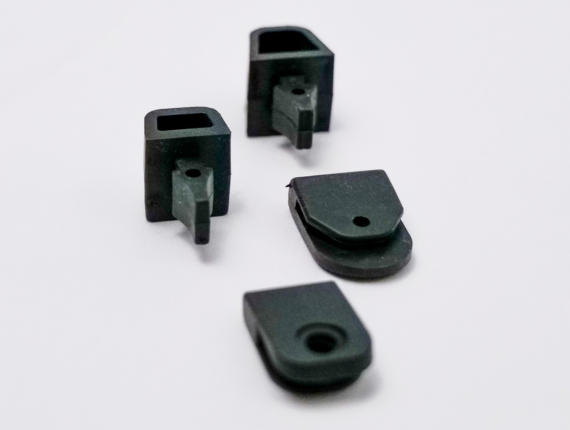
EPDM can therefore serve a number of purposes, depending on the project:
- to cushion the contact between two components;
- to minimise noise and vibration in the boot;
- to protect a surface from repeated impacts;
- secure the movement with a cord or boot strap;
- to act as a counterweight when a mass is required.
The shape, dimensions, Shore hardness, mass and method of fitting the stop are determined on the basis of its operating environment and the project specifications.
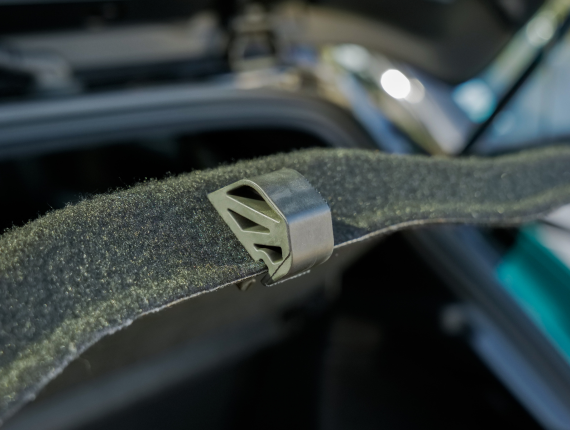
EPDM stop for car boot: to hold the shelf in place
In the boot of a car, the EPDM stop plays a simple but essential role: keeping the shelf pressed firmly against the vehicle’s structure, with no play.
When the vehicle is moving, the vibrations and forces transmitted by the chassis are passed on to the various components in the passenger compartment.
Without sufficient support, the tablet may move slightly, lose contact with its base and then bump into it again.
These minute movements can cause unwanted rattling noises, which are particularly noticeable inside the passenger compartment.
The EPDM stop helps to limit this phenomenon in two ways: it keeps the parts in constant contact and helps to dissipate some of the energy transmitted by the chassis.
Shore hardness: a key parameter
To ensure this component functions correctly, the choice of Shore A hardness for the EPDM is crucial.
The aim is to ensure there is sufficient preload when the tablet rests against the stop. This preload keeps the various components in contact, even when they are subjected to the vehicle’s vibrations and stresses.
The right balance is essential:
- A stop that is too loose results in insufficient preload: under the effect of vibrations, the shelf may momentarily lift off its support and then come back into contact with it, causing a clattering noise;
- A stop that is too stiff absorbs loads less effectively and is more likely to transmit forces to the structure, which can also cause noise.
A stop tailored to your requirements
The performance of an EPDM stop does not depend solely on its material. Its geometry, thickness, position, contact surface and degree of compression also influence its behaviour.
These settings are determined on the basis of the room’s environment and the manufacturer’s specifications.
The EPDM ball on the shelf supports
One of the applications developed by Eurosandow relates to the rear shelf lifting straps.
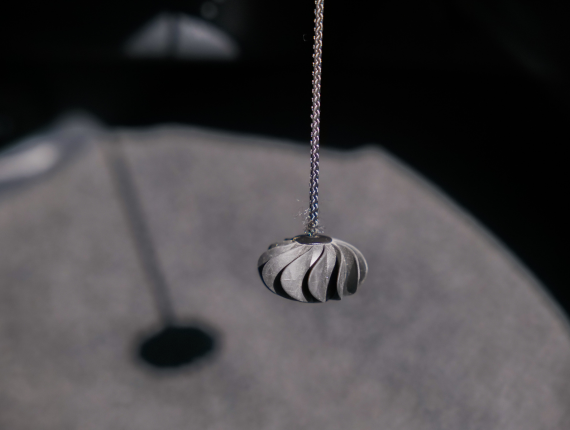
These cables connect the shelf to the tailgate so that it lifts automatically when the boot is opened. They can incorporate various end fittings or overmoulded components, as well as an EPDM ball.
This sphere serves two main purposes.
Firstly, its weight allows the cord to drop naturally back into the boot when the tailgate closes. This reduces the risk of the cord becoming misaligned or getting caught in the tailgate.
Furthermore, the flexibility of EPDM helps to reduce contact noise when the ball moves and comes into contact with the shelf or the side of the boot.
A single component therefore serves both as a counterweight and as a sound-dampening element.
Velcro strap for the boot: to secure the load
To keep certain items secure in the boot, Eurosandow also manufactures rigid straps fitted with Velcro-type hook-and-loop fasteners.
The principle is based on two complementary surfaces, one consisting of hooks and the other of loops. A simple press is all it takes to secure them together, whilst the fastening can still be undone by hand.
In a car boot, this solution can be used to hold an object in a specific position and prevent it from moving whilst travelling.
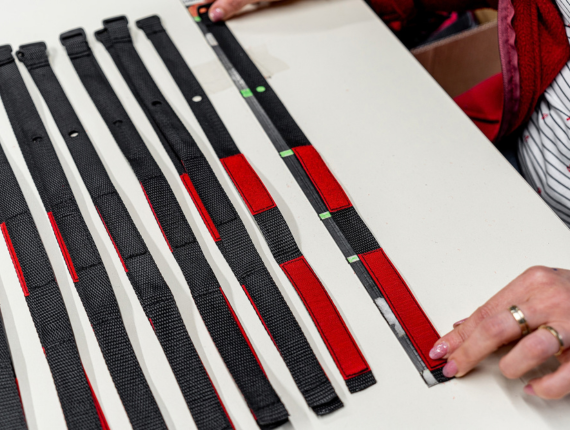
Why use a rigid strap with Velcro?
Choosing a rigid strap meets this need for stability.
Unlike an elastic strap, it does not stretch: the length remains constant and the object stays in place.
It also retains its properties well over time, as it does not contain any latex, which is prone to gradually losing its elastic properties as it ages.
The Velcro strip is sewn directly onto the strap.
Its length, position and stitching area can be adapted to the system’s geometry, the object to be secured and the constraints of fitting it into the boot.
A solution tailored to your automotive specifications
The design of an EPDM bumper or a Velcro strap for a boot depends directly on the environment in which it is used.
When analysing an EPDM buffer or ball, several pieces of information are particularly useful: the component with which it will be fitted, its location within the vehicle, how it is secured, and its intended function — damping, noise reduction or ballast.
For a rigid strap with a hook-and-loop fastener, it is particularly important to specify the width of the strap, its length, the position of the Velcro, the fastening system and the object to be secured.
The requirements set out in the automotive specifications then supplement this information.
Thanks to its expertise in straps, nets, cords, sewing techniques and bespoke solutions, Eurosandow can incorporate these components into a comprehensive solution designed for the vehicle boot.
Frequently Asked Questions
What is the purpose of an EPDM stop in a car boot?
In particular, an EPDM buffer helps to keep the shelf pressed firmly against the vehicle’s structure and eliminates any play between the parts. Its flexibility also helps to absorb vibrations and minimise unwanted noise.
Why use EPDM in a car boot?
EPDM combines flexibility with resistance to environmental stresses such as temperature fluctuations, UV radiation and ozone. Its ability to absorb impact makes it particularly suitable for certain automotive applications.
What is the purpose of an EPDM ball on a rear shelf support?
In particular, the ball helps to weigh down the cord so that it retracts more easily into the boot when the tailgate closes. Its flexible material also helps to minimise noise when it comes into contact with the boot floor or the sides.