

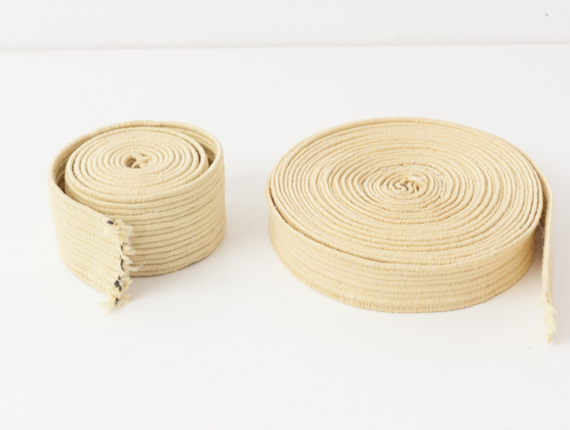
Aramid webbing (also known under the brand names Kevlar® or Twaron®) is much more than just a simple strip of fabric. Woven or braided from para-aramid fibres, it offers exceptional mechanical performance.
Extreme resistance to breakage, abrasion and very high temperatures… all combined with surprising flexibility.
Please note, however, that whilst aramid excels in demanding environments, it is naturally sensitive to UV rays – a key factor to bear in mind for your outdoor projects.
The technical properties of aramid webbing
Aramid and Kevlar – what’s the difference?
None, in the sense that Kevlar® is not a distinct material: it is the trade name registered by DuPont for its para-aramid fibre, which has been on the market since 1971. Twaron® refers to Teijin’s para-aramid, which has similar properties. Nomex®, which is often confused with it, belongs to the meta-aramid family: it is designed for thermal protection rather than mechanical strength. A Kevlar strap and an aramid strap therefore refer to the same type of product, the latter being the correct technical designation.
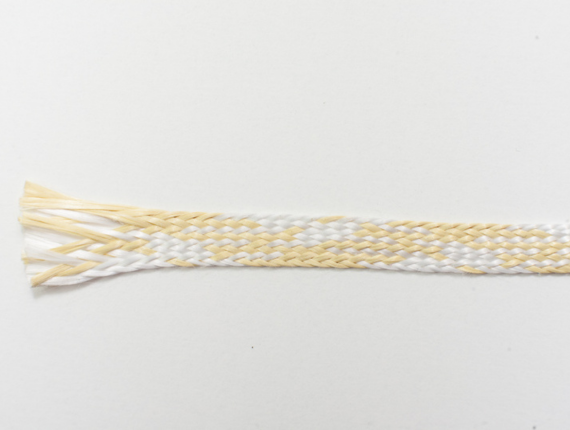
Aramid fibre occurs as continuous filaments, which are naturally golden-yellow in colour. The strength of para-aramid yarn is due to the orientation of its molecules. For the same cross-sectional area, it can bear several times the load of a steel wire, whilst weighing considerably less.
| Criteria | Level |
| Tensile strength | Perfectly suited (5/5) |
| Heat resistance | Perfectly suited (5/5) |
| Abrasion resistance | Perfectly suited (5/5) |
| Sun exposure (UV) | Not suitable (1/5) |
| Moisture resistance | Perfectly suited (5/5) |
| Flexibility (density) | Perfectly suited (5/5) |
| Buoyancy | No |
| Storage in a damp environment | Very suitable (4/5) |
This table can be read at a glance. It meets five out of a maximum of six criteria, and at least one. Aramid is the only fibre in the ranking to achieve full marks for tensile strength, heat resistance, abrasion resistance, moisture resistance and flexibility. Polyethylene performs equally well in terms of tensile strength and abrasion resistance, but falls short on heat resistance. No other material performs well on all three fronts at the same time.
Aramid’s fire behaviour stands out from that of other materials. Aramid does not burn or melt: it carbonises at around 500 °C. Whilst polyester and polyamide melt at temperatures between 215 and 260 °C, aramid webbing retains its structural integrity well beyond these temperatures, without a single drop of molten material.
The chemical sensitivities identified relate to concentrated mineral acids, strong acids and strong alkalis at high temperatures. Aramid does not float.
The advantages of aramid webbing
Le rapport résistance/masse
C’est l’argument clé. Une sangle aramide peut supporter des charges très élevées sur une section réduite, ce qui allège l’ensemble embarqué. En aéronautique, où chaque gramme compte, cet écart justifie seul le surcoût matière.
La tenue à la chaleur et au feu. Ne brûle pas, ne fond pas, carbonise vers 500 °C. Cela ouvre les environnements que les polyesters et polyamides interdisent : proximité de sources chaudes, exigences feu-fumée-toxicité, zones à risque incendie. La sangle ne produit ni gouttes fondues ni bords vitrifiés.
Résistance à l’abrasion
Passage en boucle sous tension, frottement sur arête, contact métallique répété : l’aramide encaisse là où les autres fibres cèdent. Le Kevlar s’impose donc comme le matériau de choix pour les sangles soumises à des frictions répétées. Sa durabilité garantit la pérennité de vos installations et élimine les surcoûts liés aux remplacements fréquents.
Souplesse de la fibre
À l’état de fil ou de tissu tissé, l’aramide offre une excellente souplesse. En revanche, plier ou nouer de manière répétée un câble ou un tissu en aramide finit par briser ses microfibres internes.
Technical limitations to be aware of
Les ultraviolets
C’est la seule limite majeure de ce matériau. Les rayons du soleil altèrent la structure moléculaire des fibres et par conséquent les performances globales de la sangle. Une exposition prolongée en extérieur réduit la charge de rupture et le tissu aura tendance à jaunir sous l’effet des rayons du soleil.
Pour les applications en extérieur, il est préférable de recouvrir la sangle d’une gaine de protection (en polyester par exemple) ou des stabilisants anti-UV pour la préserver.
Le coût
Le coût d’un tissu d’aramide (comme le Kevlar) se situe généralement entre 20 € et 40 € par mètre carré, selon le grammage, le type de tissage et la quantité achetée. ce matériau reste plus cher que des fibres synthétiques classiques comme le polyester.
Résistance à certains produits chimiques
L’aramide offre une excellente résistance chimique globale, mais sa tolérance varie selon la nature et la concentration des substances en contact.
Il faut éviter le contact prolongé ou direct avec des acides forts et concentrés, qui peuvent dégrader la fibre.
Personnalisation limitée (coloris)
La fibre est jaune à l’état naturel et sa structure moléculaire la résistantes à de nombreux colorant. Les coloris disponibles sont restreints, ce qui limite son emploi sur des pièces visibles avec une contrainte esthétique.
Aramid, polyamide or polyester: how to decide
| Criteria | Aramid | Polyamide | Polyester |
| Tensile strength | Perfectly suited | Very suitable | Very suitable |
| Abrasion resistance | Perfectly suited | Very suitable | Very suitable |
| Heat resistance | Perfectly suited | Suitable | Suitable |
| Sun exposure (UV) | Not suitable | Suitable | Suitable |
| Flexibility | Perfectly suited | Very suitable | Very suitable |
| Reaction to heat | Does not burn; chars at around 500 °C | Melting point 215–260 °C | Melting point 255–260 °C |
The decision comes down to one question: does the thermal or mechanical stress exceed what the polyester can withstand? If so, aramid is the only option in the classification. If not, the extra cost is not justified, and the polyester webbing will do the job. In between these two scenarios, polyamide webbing remains the preferred choice whenever the load is applied in the form of impacts, thanks to its elasticity, which aramid lacks. One final point: if the webbing is constantly exposed to sunlight, avoid using aramid regardless of the load.
Pour en savoir plus sur les performances des autres matériaux, n’hésitez pas à consulter notre guide complet.
Widths, thicknesses and packaging options
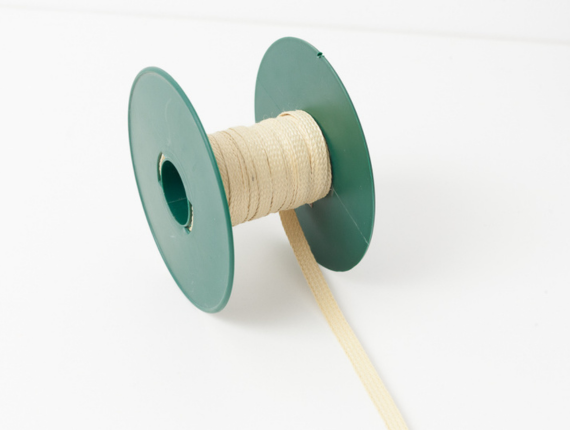
Our aramid straps are available in widths ranging from 5 to 50 mm and thicknesses from 0.5 to 5 mm, in woven or braided construction, and in flat or tubular forms.
| Catalogue reference | Diameter | Packaging |
| V19705A | 5 mm | 100 meters |
| V19710A | 10 mm | 100 meters |
| V19715A | 15 mm | 100 meters |
| V19720A | 20 mm | 100 meters |
| V19725A | 25 mm | 100 meters |
| V19730A | 30 mm | 100 meters |
| V19735A | 35 mm | 100 meters |
| V19740A | 40 mm | 100 meters |
| V19745A | 45 mm | 100 meters |
| V19750A | 50 mm | 100 meters |
Have your custom-made aramid webbing manufactured
When you work with us, you’re choosing end-to-end expertise for your technical webbing. Our bespoke support covers:
Full traceability: For your safety components, we provide a comprehensive dossier, from the raw material batch right down to the coil number.
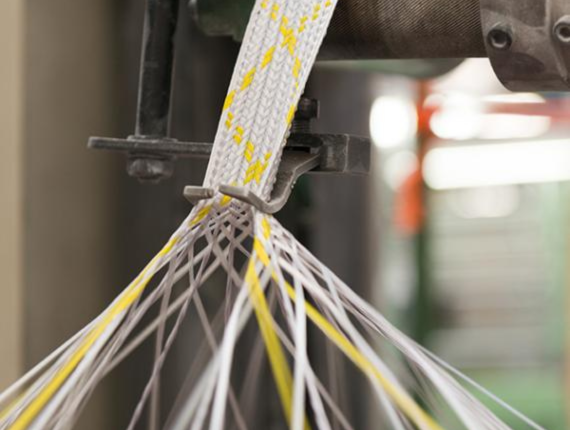
Technical design: Choice of yarn (para-aramid, denier, origin), construction, UV-protection treatments and finishes (end treatments). Our design office takes your specifications on board right from the outset of the project.
A long-standing tradition of craftsmanship: Our workshops in Saint-Étienne specialise in weaving, braiding, knitting and Jacquard weaving.
Proven quality: Each product is subject to a strict quality control programme (tensile strength, elongation, abrasion resistance, dimensions).