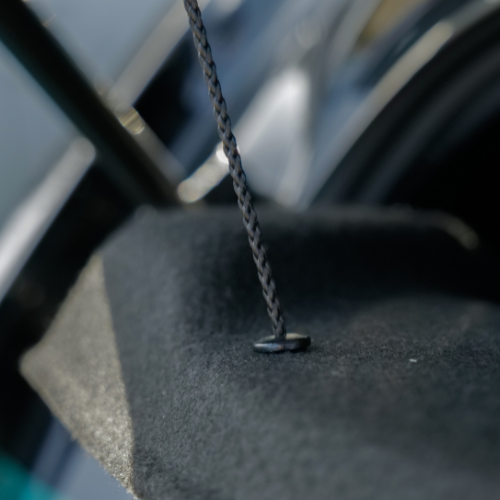
In a vehicle’s interior, many elements are adjustable, including seats, tables, and storage spaces. To function properly, these elements rely in particular on elastic cords capable of accompanying these movements without stretching or breaking.
Discreet yet indispensable, elastic cords ensure that many pieces of equipment function properly. It is thanks to them that a rear shelf lifts smoothly and a net remains stretched tight.
Subject to high stresses, these products must be both strong and flexible in order to maintain their performance even after repeated use.
The different types of cords for vehicle interiors
Depending on their position in the car, elastic cords perform very different functions.
They can limit movement, maintain tension, or simply accompany the movement of another element.
Each type of cord is designed to meet specific requirements: mechanical strength, elongation, flexibility.
Rear shelf straps and movement limiters
The stringing cords for car seats
Fastening cords and tensioners for storage nets
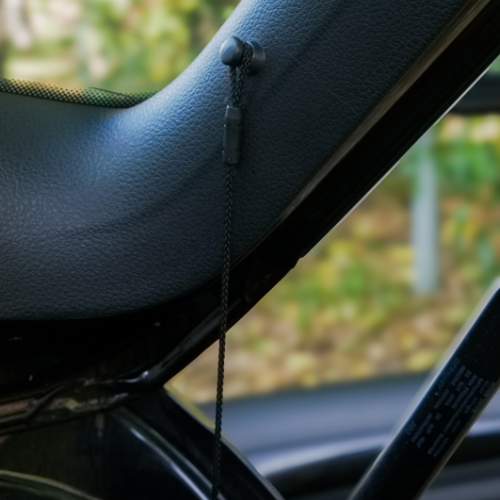
The cords connect the shelf to the tailgate of the car trunk.
Each time it is opened or closed, they ensure smooth, regular movement while keeping the shelf in the correct position.
These movement limiters are designed to withstand repeated cycles without losing tension or risking breakage.
Their elasticity must be controlled: if they are too flexible, the movement becomes unstable; if they are too rigid, the part wears out prematurely.
It is this delicate balance between elasticity and resistance that guarantees the reliability of the system over time.
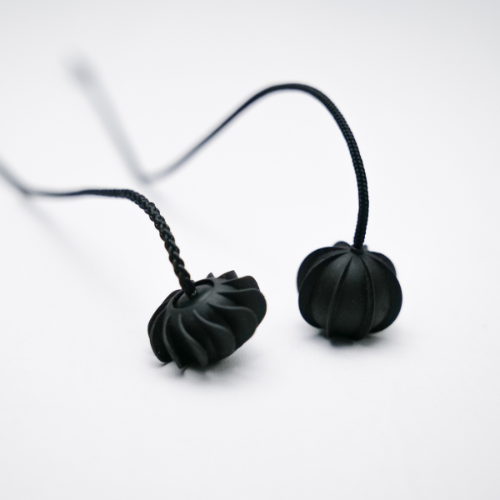
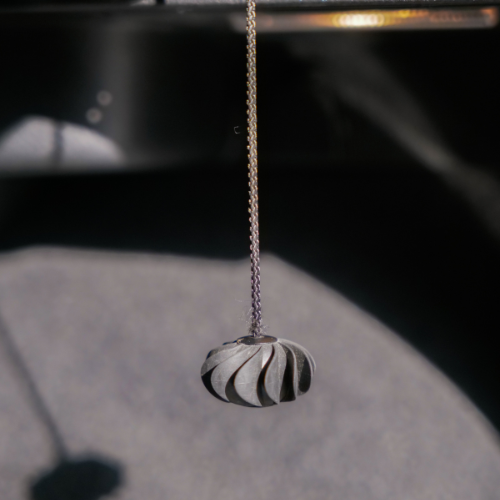
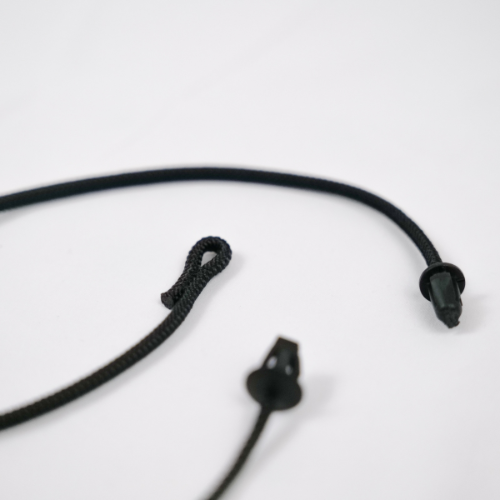
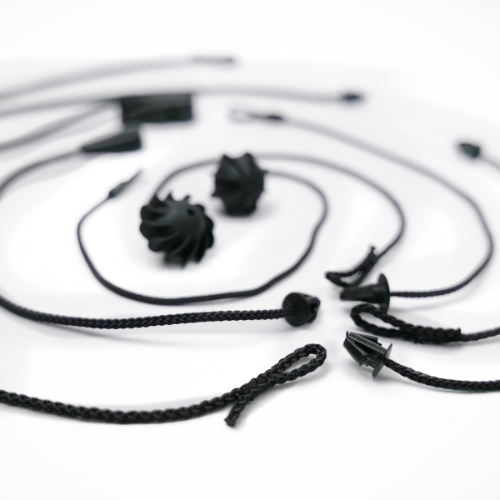
This type of cord generally incorporates overmolded fastening ends. Some are equipped with an EPDM sphere. This small element prevents the cord from getting stuck in the trunk lid.
The sphere is heavy enough to descend into the trunk and prevent the cord from getting stuck. Made of a flexible material, it eliminates noise when moving, ensuring optimal acoustic comfort.
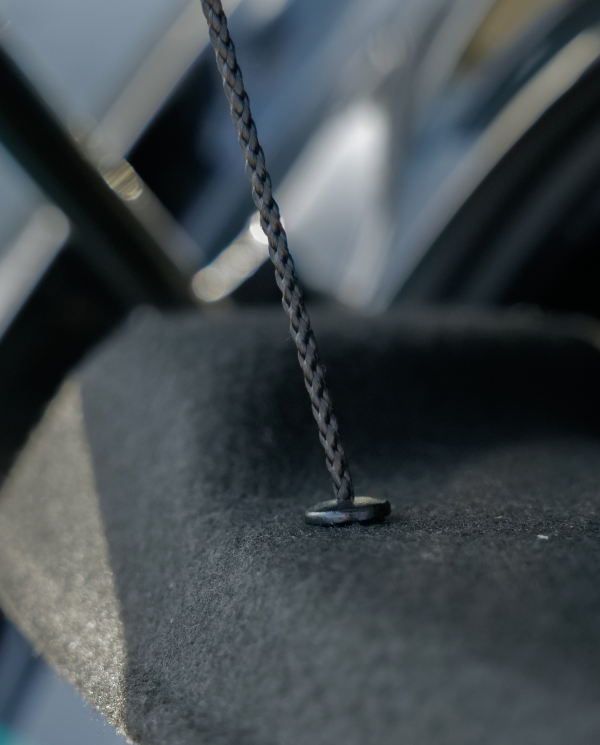
Stringing cords are used when assembling upholstered seats.
They serve to keep the cover (fabric or leather) taut over the foam, without creases or deformation. They thus ensure that the seat upholstery remains in place.
Although invisible once the seat is assembled, drawstrings have a direct impact on perceived quality. This level of finish contributes significantly to seating comfort, the feeling of quality, and, more broadly, the overall customer experience.
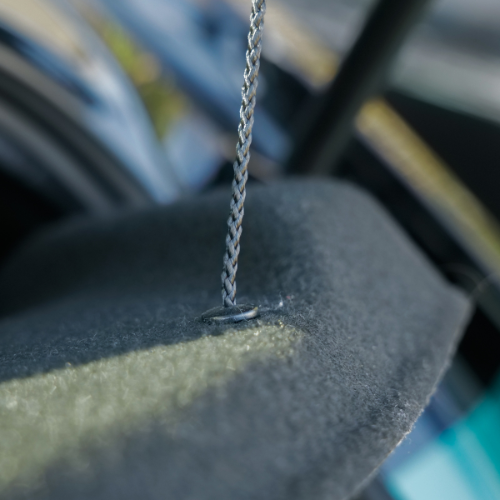
Storage nets located behind the front seats of the car, on the side panels, or in the trunk are often made up of a frame with elastic cords. They allow the net to be easily stretched to store items.
The cords must be designed to absorb a certain amount of stretching without the risk of breaking.
Choice of cord dimensions and materials
Selecting dimensions
As a crucial step in product design, you must begin by defining the key characteristics of the cord.
The diameter will have an impact on the technical properties of the product. Elastic cords are generally available in diameters ranging from 1.5 to 8 mm, depending on requirements.
The smallest diameters are suitable for elements that do not require high tensile strength, such as small storage nets.
Larger diameters are suitable for elements requiring high return force, such as shelf supports.
The length of the cable will also depend on several factors, such as the distance between the two attachment points, the required elongation, etc.
Choosing the wrong dimensions will impact the performance and safety of the product.
Choice of materials
Each component of the cord can be made from different materials.
We offer covers made from high-quality materials such as polyethylene, polypropylene, polyester, cotton, polyamide, Kevlar, aramid, fiberglass, and even copper, ensuring strength and durability.
The core of our cords can be made of natural latex, Fulflex, elastane, elastomer, or EPDM. These materials are carefully selected to ensure optimal performance, tailored to each use.
What are the key features to consider?
Cables designed for the automotive industry must meet numerous performance and quality criteria.
Determine the elongation parameters
When designing the product, the elongation and return force required to stretch the elastic are defined in order to perfectly suit a given use.
Unlike a rope, which is designed to support a load, an elastic band deforms to perform a certain function before returning to its original shape.
The elastic band therefore deforms up to a certain threshold, beyond which it is highly likely to tear. It is in this sense that the term “resistance” cannot be applied. It is therefore important to use an elastic band that is suitable and designed to perfectly meet the required application.
Tensile strength and fatigue resistance
Subjected to multiple cycles of use, this type of cord must maintain its performance over time. Fatigue tests measure physical stress by stretching the elastic. An extensometer measures elasticity while sensors indicate the force applied. Several cycles are performed to ensure that the product retains its properties.
Compliance with automotive industry regulations
The cords used in vehicle interiors must meet strict requirements defined by the automotive industry.
As they are integrated into the passenger compartment, in the seats, panels, and trunk, these components must guarantee passenger safety.
One of the major constraints concerns fire safety standards.
The materials used in the cords (fibers, sheaths, end caps, EPDM spheres, etc.) must comply with flammability resistance standards imposed by manufacturers and international regulations.
The aim is to prevent the spread of flames in the passenger compartment and to limit toxic smoke emissions.
To guarantee their reliability, cables intended for the automotive industry are subjected to a series of rigorous tests, carried out in accordance with manufacturers’ standards and current regulations.
Manufacturing process for automotive elastic cords
This type of product is usually braided. The performance of a vehicle interior cord therefore depends largely on the quality of its braiding.
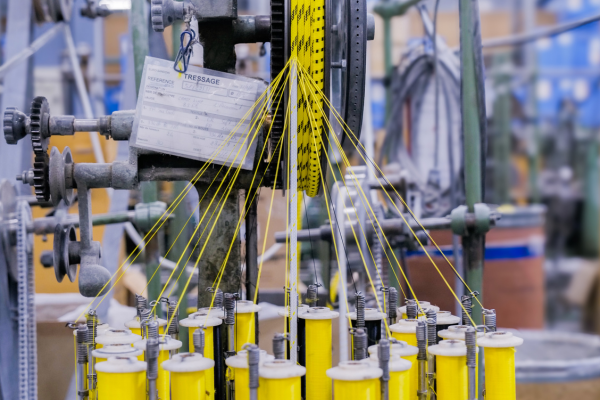
This manufacturing process involves covering the elastic core of the cord with textile threads using rotating spools of thread.
The spools are placed on a support called a “spindle” which rotates the threads. Each spindle follows a sinusoidal guide path machined into the machine table.
This technique can be used to produce three types of braids: tubular braids, round braids, and flat braids.
The choice of braiding type will depend on the intended use and desired final characteristics of the product.
Thanks to our 150 braiding machines, combined with our 30 different crimping machines and our 5 manual or automatic overmolding presses, we are able to design numerous cord models.
Example of cables manufactured for automotive manufacturers
With nearly a century of expertise in textile manufacturing, Eurosandow has developed extensive know-how in designing solutions for vehicle interiors.
Over the decades, we have supported numerous automotive manufacturers and equipment suppliers, developing solutions tailored to their technical constraints and quality requirements.
Here are some examples of products we have created for our clients:
➡️ In 2025, we launched mass production of a new tailgate lift cord for the Fiat Panda. Attached to the tailgate, it allows the tailgate to be raised when the vehicle’s trunk is opened.
Expected volume: 160,000 units per year
➡️ In 2024, we began production of a cord used to tighten the seat of the new 2024 Duster model.
This cord, which is braided and overmolded in France, has been on the market since May 2024 and is produced at a rate of approximately 650,000 pieces per year.
Its production is 100% automated. This allows us to reduce the unit production cost and manufacture this part in France!
➡️ Custom-made lift cord for the trunk of a Stellantis Group car model
A total of 900,000 parts will be produced per year for this project.
Each project is unique. Based on the specifications and information provided by our customers, we are able to design solutions tailored to a variety of applications.