

Discreet but indispensable, elastic cables for car seats play a key role in the comfort and reliability of a vehicle. Behind every seat back and every well-tensioned seat cushion is a system designed to absorb movement and maintain tension. It contributes directly to the comfort, stability, and durability of the seat, while meeting the constraints of the automotive industry.
Elastic cables for car seats come in different forms depending on their function and location. The end use of the cable influences the choice of materials and its properties.
The functions of elastic cables in car seats
Elastic cables are used at various stages in the design and assembly of car seats. Their role is not limited to maintaining tension: they contribute to the functional structure of the seat, its comfort and mechanical durability. Depending on their position and function, several types of cables are used:
Elastic seat fastening cords
Cords for seat nets
Stringing cords
Elastic seat fastening cords are integrated into the seat structure, often inside the backrest or seat cushion. Their function is simple: to allow the seat to return to its original shape after use.
This return system ensures constant tension, which contributes to the support of the backrest, the stability of the padding, and passenger comfort.
By absorbing some of the movements and vibrations, these cables also improve the feeling of comfort while driving, while extending the life of the seat.
At the back of the front seats or on the sides, storage nets are held in place by elastic cords.
Their function is to keep the net taut, while allowing it to stretch easily when you want to store or stow an item.
Stringing cords are used when assembling upholstered seats. They are used to secure the cover (fabric or leather) to the seat foam, ensuring even tension across the entire surface.
Thanks to these cords, the cover stays in place without wrinkles and retains a neat appearance. Their role is therefore both aesthetic and functional: they contribute to the perceived quality of the seat while ensuring the stability of the upholstery over time.
Materials and finishes for elastic cables for car seats
The choice of materials is a key factor in the design of an elastic cable for car seats. It determines the product’s lifespan, its mechanical behavior, and its compatibility with the assembly processes used by manufacturers and equipment suppliers.
Each element—the core, the sheath, and the finishes—fulfills a specific function in the cable’s performance.
The core
The core of the cable can be made from several materials such as natural latex, fulflex, elastane, elastomer, EPDM, etc.
The choice of material will depend on the end use of the product and the associated technical constraints.
Depending on requirements, we adjust the elongation and force parameters to achieve the desired deformation. Our elastic cables are designed to absorb a certain amount of deformation and respond to a specific force and stress.
The cover
It protects the cable from external damage and ensures a clean finish for integration into the seat.
The cable cover can be made from various materials: polyethylene, polypropylene, polyester, cotton, polyamide, Kevlar, aramid, fiberglass, carbon fiber, copper, Technora, etc.
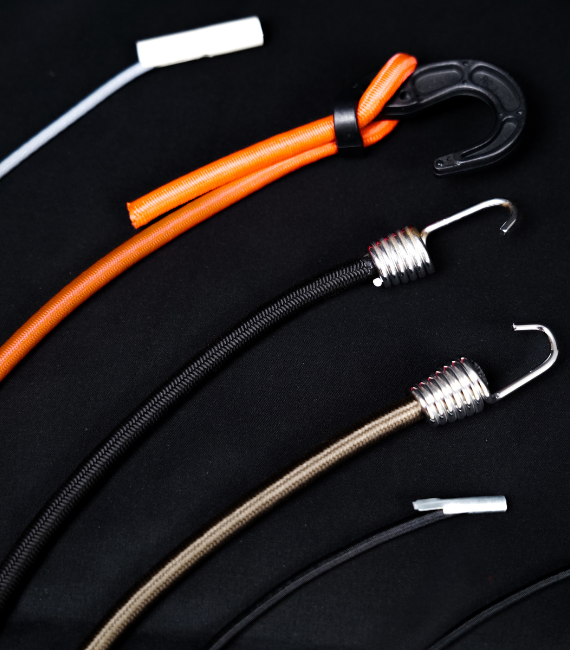
Mounting accessories:
Different types of end fittings can be used to attach the elastic cable to the car seat structure. The choice of fastening system depends on the mechanical stresses exerted on the cable and the intended assembly method. A suitable fastening system ensures safe installation and prevents any risk of breakage.
Cables, bungee cords, and tensioners can be equipped with steel hooks, molded hooks, or crimped end fittings to ensure excellent durability over time.
What are the advantages of this type of product?
Controlled and lasting tension
One of the main advantages of elastic cables is their ability to maintain constant tension.
Whether used as a tensioner or a stringing cord, the cable retains its tensile strength over time, even after thousands of cycles of use.
This stability guarantees the shape and support of the seat, while limiting deformation of the padding and covers.
Improved user comfort
By accompanying the movements of the backrest and seat, the elastic cable directly contributes to the dynamic comfort of the seat.
It absorbs some of the movements and vibrations, which improves the feeling of flexibility and reduces fatigue during long journeys.
Easy integration
For equipment manufacturers, the performance of a flexible cable is not limited to its mechanical properties: it also depends on how easy it is to integrate into the assembly line.
The cables are designed to adapt to existing industrial processes, whether manual, semi-automated, or fully robotized assembly. Their flexibility, lightness, and dimensional stability make them easy to install, without the need for complex adjustments or special tools.
Another advantage is that elastic cables can be delivered cut to length, pre-equipped, or packaged according to the customer’s assembly method. This approach simplifies logistics, improves assembly repeatability, and guarantees productivity gains without compromising the final quality of the seat.
Manufacture of cables, bungee cords, and tensioners for the automotive industry
Manufacturing an elastic cable for a car seat requires extreme precision. Behind this seemingly simple component, every detail counts: tension, resistance, uniformity of braiding, and quality of assembly.
Design
Before producing a cable, everything starts with a design phase.
The technical teams define the diameter, elasticity level, tensile strength, and type of sheath according to the cable’s function in the seat.
Choice of manufacturing process
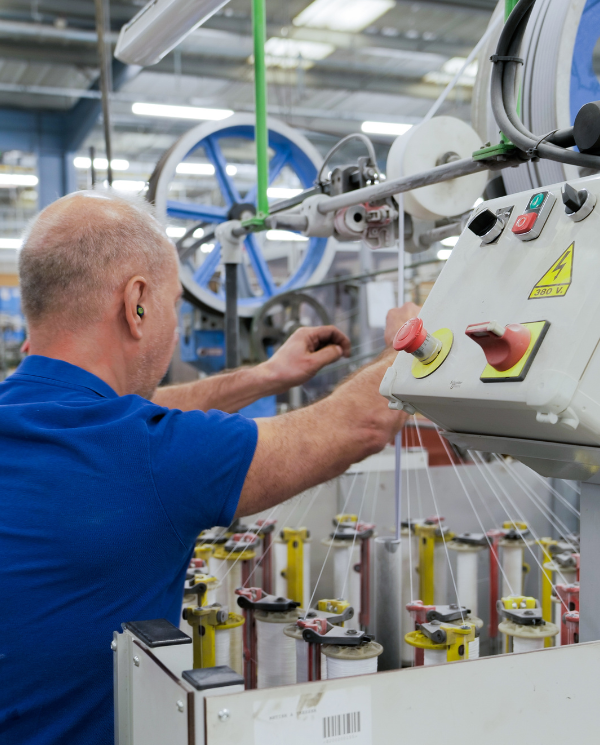
The manufacture of elastic cables is mainly based on a braiding process.
The core of the cable, composed of an elastic thread often made of latex, is covered with textile threads intertwined according to a precise rotation of spools.
At Eurosandow, our fleet of 150 braiding machines offers high production capacity and responsiveness tailored to industrial needs. This equipment allows us to produce complex braids, varying the width or thickness of the thread according to the application requirements.
We can combine different types of covering materials, such as polyethylene, polypropylene, polyester, cotton, polyamide, Kevlar, aramid, fiberglass, copper, carbon fiber, flax, and hemp. This flexibility allows us to create products with very specific technical characteristics.
Rigorous quality controls
Once braiding and production are complete, each product undergoes various mechanical tests to ensure its quality and reliability.
We check their tensile strength, maximum elongation, behavior after several tension cycles (fatigue testing), and stability when exposed to heat or humidity.
We can therefore provide our customers with simple inspection reports or certificates of conformity to guarantee product quality.
Co-creating with automotive equipment manufacturers
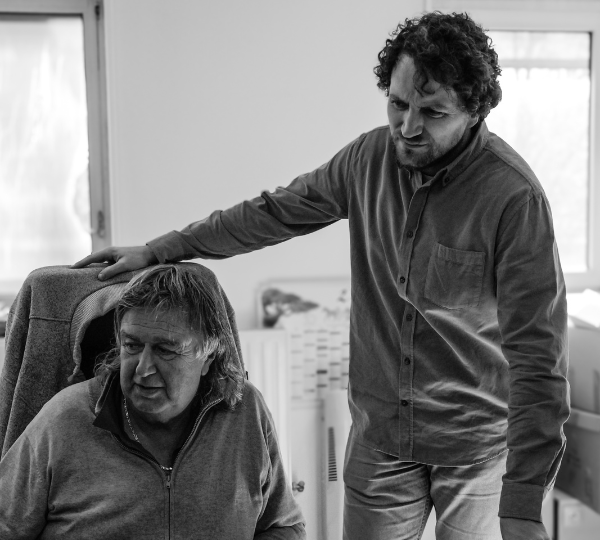
The success of an automotive elastic cable also depends on collaboration between the manufacturer and equipment manufacturers.
Technical exchanges enable the product’s characteristics to be adjusted to the constraints of the seat, the assembly methods, and more broadly, the specifications.
A responsible and sustainable approach
The automotive industry is moving towards increasingly sustainable solutions, and textile components are no exception.
The manufacture of elastic cables is now part of a process of resource optimization, which involves selecting more responsible materials.
More environmentally friendly materials
A growing proportion of the cables produced now incorporate recycled or bio-based fibers from certified sources.
These materials retain excellent mechanical performance while limiting the use of virgin resources.
The use of natural fibers such as cotton, linen, or hemp, or recycled polymers such as polyester or polypropylene, reduces the overall impact of the product without compromising its strength.
A mastered manufacturing process
Manufacturing is based on low-energy braiding processes, optimized to reduce material waste.
Textile scraps are sorted and recycled as much as possible, with a view to reuse or internal recycling.
The proximity between production sites and European customers also limits transport distances and therefore logistics-related emissions.