

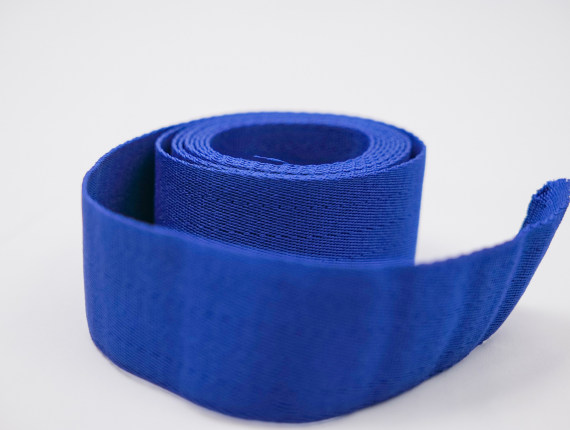
Polyamide strap is a woven or braided textile strip made from polyamide fibres, more commonly known as nylon webbing. It combines high tensile strength, excellent abrasion resistance and elasticity, which enables it to absorb shocks rather than transmit them. It is this latter property that sets it apart: where a polyester webbing remains rigid, a polyamide webbing flexes. It is therefore primarily used in applications subject to dynamic loads, from lifting slings to hold nets.
The technical properties of polyamide webbing
What is polyamide?
Polyamide is a synthetic polymer produced by polycondensation, which is commercially available in two main types: PA 6 and PA 6.6, the latter offering slightly better heat resistance. The terms ‘nylon’ and ‘polyamide’ refer to the same material, with ‘nylon’ being the historic trade name registered by DuPont in the 1930s. A nylon webbing and a polyamide webbing are therefore one and the same product.
Unlike cotton, a short fibre spun into staple fibre, polyamide is extruded into continuous filaments. A yarn made from continuous filaments has a smooth surface, greater tenacity and a more uniform cross-section than can be achieved by spinning. This is the primary reason for the difference in mechanical performance between the two materials.
| Criteria | Level |
| Tensile strength | Very suitable (4/5) |
| Heat resistance | Suitable (3/5) |
| Abrasion resistance | Very suitable (4/5) |
| Sun exposure (UV) | Suitable (3/5) |
| Moisture resistance | Perfectly suited (5/5) |
| Flexibility (density) | Very suitable (4/5) |
| Buoyancy | No |
| Storage in a damp environment | Suitable (3/5) |
Two properties account for the bulk of this material’s value. Both tear strength and abrasion resistance are rated at level 4 out of 5, placing polyamide near the top of the rankings, behind aramid and polyethylene but ahead of polypropylene and all natural fibres. In terms of moisture resistance, the fibre achieves the highest rating: it does not degrade on contact with water and can withstand storage in a damp environment to a reasonable extent.
In terms of thermal properties, polyamide is flame-resistant and does not support combustion. Its melting point is between 215 and 260 °C. Chemically, it is known to be sensitive to concentrated mineral acids, formic acid and acetic acid, as well as certain phenols. Polyamide does not float.
The advantages of polyamide webbing
Energy absorption: This is the key structural feature. The fibre’s elasticity enables it to absorb an impact by stretching, then gradually release the force. On a cargo net, a sling or a shock-absorbing strap, this property prevents sudden peaks in tension that jeopardise the anchor points. A polyester strap, which is more dimensionally stable, transmits the force almost in its entirety.
Abrasion resistance: Level 4 out of 5, the highest level amongst commonly used fibres. Polyamide withstands repeated rubbing, looping and contact with metal fittings without wearing out quickly. This is a key factor in the service life of any strap that is used on a daily basis.
Tensile strength: Also 4 out of 5. Combined with its low weight, this allows high loads to be carried on moderate cross-sections, which is important when the weight of the payload becomes a factor.
Fire behaviour: The fibre is flame-retardant and does not support combustion, with a melting point of up to 260 °C. This provides a solid foundation for regulated sectors, to be supplemented by specific treatment where required by the standard.
Flexibility: Level 4 out of 5. The webbing is easy to work with, can be sewn without difficulty and is suitable for complex finishes, including crimping and fittings

Technical limitations to be aware of
Sensitivity to acids: This is the best-documented limitation. Mineral acids, concentrated formic and acetic acids, and certain phenols: in these environments, the fibre degrades.
Point to note: polyester has the opposite behaviour, as it is sensitive to strong alkalis but is more resistant to acids. The choice of material therefore depends in part on the chemical nature of the environment, not just on mechanical properties.
UV resistance: Level 3 out of 5 only, the same as polyester in this ranking, and lower than polypropylene. For continuous exposure to sunlight, a UV-protective treatment is essential.
Creep under sustained load: The elasticity that makes polyamide so valuable in dynamic applications becomes a drawback in static applications. Under constant, prolonged tension, the webbing stretches and loses its initial tension. For a permanent fastening that must retain its dimensions, polyester remains the more suitable choice.
Lack of buoyancy: Polyamide sinks. Marine applications requiring a strap to float on the surface are best suited to polypropylene or polyethylene.
Polyamide or polyester: how to decide
| Criteria | Polyamide | Polyester | Cotton |
| Tensile strength | Very suitable | Very suitable | Suitable |
| Abrasion resistance | Very suitable | Very suitable | Not particularly suitable |
| Heat resistance | Suitable | Suitable | Not particularly suitable |
| Flexibility | Very suitable | Very suitable | Perfectly suited |
| Storage in a damp environment | Suitable | Very suitable | Not particularly suitable |
| Sensitive to | Concentrated acids, certain phenols | Strong alkalis, certain phenols | Sulphuric acid |
This table calls for an honest interpretation: in terms of mechanical criteria, this source does not distinguish between polyamide and polyester. Both fibres receive identical scores for tensile strength, abrasion resistance, heat resistance and flexibility. The decision is therefore based on two other factors.
The first is behaviour under load. Polyamide stretches and absorbs stress, whilst polyester retains its dimensions. Dynamic stresses and impacts on the one hand; firm support and permanent fastening on the other. The second is the chemical environment, where the two fibres are exactly complementary: acids for polyester, bases for polyamide. For less demanding applications, polypropylene webbing remains a cost-effective alternative, whilst for contact or aesthetic applications, cotton webbing takes over.
20, 25, 40 or 50 mm nylon webbing: widths and packaging options
Four widths cover the majority of requirements, and the choice is based less on aesthetics than on the load to be supported and the space available in the fittings.
The 20 mm nylon webbing and the 25 mm nylon webbing are used for lightweight components and space-saving fastenings, with buckles and end fittings as standard. The 40 mm nylon webbing marks the threshold for medium-duty applications: lashing straps, harnesses and equipment fastenings. The 50 mm nylon webbing, also referred to as 50 mm polyamide webbing, remains the standard width for lifting and lashing applications, as it distributes the load over a sufficient surface area to minimise pressure on the secured item.
Our straps are available in widths ranging from 10 to 50 mm, in either rigid or elastic versions. Packaging is tailored to your requirements: in 100-metre reels or cut to length. Sewn end fittings, hooks, zamak buckles, swivel end caps and accessories can be fitted on request.
For non-standard widths, the design is bespoke.
Having your polyamide webbing made to measure
Working with an integrated polyamide webbing manufacturer gives you a wide range of options regarding yarn count, construction (weaving, braiding, knitting, Jacquard), surface treatments and finishes.
Our workshops in Saint-Étienne carry out all of these processes, with a design office that reviews your specifications at an early stage and draws up a testing plan tailored to each product reference: tensile strength, elongation, abrasion and dimensional checks. For safety components, we provide a comprehensive traceability dossier, from the wire batch to the coil number.
Frequently asked questions about polyamide webbing
Nylon and polyamide – are they the same thing?
Yes. Polyamide nylon is not a hybrid material but a redundancy in terminology: ‘nylon’ is the trade name for polyamide, registered by DuPont in the 1930s and which has since entered everyday language. The technical designation remains ‘polyamide’, with its variants PA 6 and PA 6.6.
What load can a polyamide strap withstand?
The breaking load depends on the width, thickness, yarn count and weave construction, not just the material. The same fibre can produce a webbing with a breaking load of a few hundred daN or several tonnes. Our technical data sheets specify the measured value for each product code.
Polyamide or polyester for lashing?
Polyester is used in the majority of cases, because lashing requires a firm hold and minimal variation in length under tension. Polyamide is preferable when the load is subject to impacts or vibrations and the aim is to absorb energy rather than transmit it.