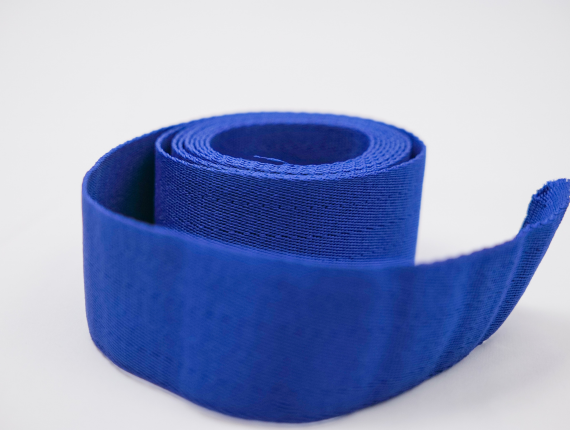
Polyester webbing is a textile strip, usually woven, made from polyethylene terephthalate (PET) yarn, which is renowned for its excellent strength-to-weight ratio.
It can withstand heavy loads whilst remaining lightweight and easy to handle. Its very low elongation under tension (around 3 to 4 per cent) ensures a firm and precise hold, making it the preferred choice for lashing, lifting, securing or assembly.
It is characterised by a higher density than polypropylene, superior mechanical strength and excellent UV resistance.
Polyester straps are available in a wide range of widths, thicknesses and breaking strengths. Colours, surface treatments, end fittings and accessories complement each configuration, depending on the intended use: transport, safety, industry or fit-out.
Structure and properties of polyester
Polyester (PET) is a thermoplastic polymer belonging to the family of saturated polyesters, produced by polycondensation. Its semi-crystalline structure gives it a density of 1.38 to 1.40 g/cm³ depending on the degree of crystallisation, which is significantly higher than that of polypropylene (0.90 g/cm³).
Its melting point lies between 255 and 265°C, with softening occurring from 230–240°C, which places it well above polypropylene (160–170°C) in terms of heat resistance.
In practice, this means that a polyester strap can withstand friction and temporary temperature spikes – for example, when passing through a pulley or during sudden braking under load – without deforming or losing its strength. This is a crucial factor whenever the strap is subjected to repeated dynamic cycles.
Its moisture absorption is very low, at around 0.4 per cent, which limits dimensional changes in damp conditions. This stability, combined with good chemical resistance and UV resistance superior to that of polypropylene, explains why polyester remains the benchmark whenever prolonged outdoor use or heavier loads are involved.
In practical terms, a polyester strap retains its original tension and dimensions even after several cycles of exposure to damp, rain or washing, unlike a natural fibre which stretches as it dries. This is what makes it reliable for outdoor lashing or marine applications exposed to the elements over the long term.
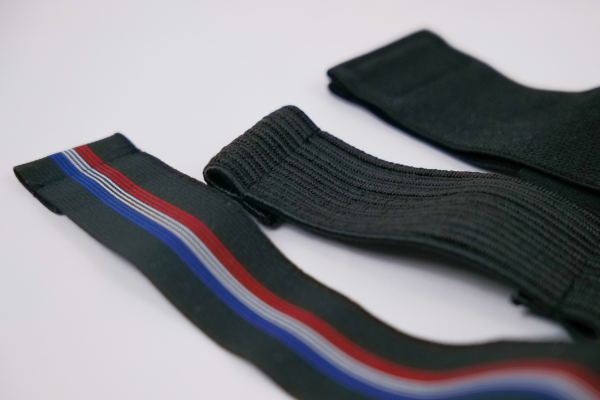
The technical strengths of polyester webbing
It has high tensile strength: the webbing can withstand heavy loads without deforming. This robustness is complemented by good abrasion resistance. Friction causes it to wear slowly, even with repeated handling or contact with sharp edges, which extends the webbing’s service life.
Its key advantage lies in its behaviour when exposed to water. Polyester is highly resistant to moisture, offering the best performance observed amongst synthetic fibres. It retains its properties over time and withstands storage in damp conditions, a real advantage for both outdoor and industrial applications.
In terms of safety, the fibre is flame-resistant and does not support combustion, with a high melting point of between 255 and 260 °C.
Limitations to be aware of
No material is suitable for every application. Choosing the right webbing also means knowing when polyester is not the best option.
Its main limitation is chemical in nature. Polyester is susceptible to strong alkalis (highly basic substances), certain phenols and solvents such as nitrobenzene. In an environment where the webbing is likely to come into contact with chemicals of this type, the fibre may degrade, and another material may sometimes be more suitable.
Secondly, polyester does not float. Unlike polypropylene or polyethylene, it sinks. For nautical applications where buoyancy is crucial, it is better to opt for a different fibre.
Its heat resistance is adequate. It covers the vast majority of applications, but falls short compared to materials such as aramid, which are designed for very hot environments.
Finally, its mechanical performance comes at a cost. Polyester remains a more expensive raw material than polypropylene, which is reflected in the price of the finished webbing. Its higher density also makes it heavier for the same width, a factor to bear in mind for equipment worn on the body or carried on board where weight is a consideration.
💡The right approach: matching the material to its actual use. This is precisely where technical support makes all the difference, in ensuring that the fibre, construction and treatments are suitable for your application.
Braided elastic polyester webbing, woven elastic or rigid elastic: which type should you choose?
Eurosandow manufactures three ranges of polyester webbing, depending on the desired textile structure and mechanical properties.
- The flat woven elastic webbing combines a natural latex core with a woven polyester cover. Available in widths of 10, 15, 20, 25, 30, 35 and 40 mm.
- The flat rigid woven polyester webbing, without an elastic component. It is available in 5, 10, 20, 25, 30, 40 and 48 mm.
- The flat elastic braided strap is based on the same principle of a natural latex core, with a braided polyester cover. It is available in 10, 15, 20, 25, 30, 40 and 50 mm.
Available widths
| Width | Braided elastic | Woven elastic | Rigid woven |
| 5 mm | ✅ | ||
| 10 mm | ✅ | ✅ | ✅ |
| 15 mm | ✅ | ✅ | |
| 20 mm | ✅ | ✅ | ✅ |
| 25 mm | ✅ | ✅ | ✅ |
| 30 mm | ✅ | ✅ | ✅ |
| 35 mm | ✅ | ||
| 40 mm | ✅ | ✅ | ✅ |
| 48 mm | ✅ | ||
| 50 mm | ✅ |
Polyester or polypropylene – which is the better choice?
These two synthetic fibres often top the list when it comes to technical webbing. However, they are not in the same league. The right choice depends on your actual use, not on one being absolutely superior to the other.
Polyester comes out on top whenever strength and durability are required. It is far more resistant to abrasion and has a higher tensile strength. Its heat resistance is also superior, with a melting point of between 255 and 260 °C, compared with just 160 °C for polypropylene.
Polypropylene does, however, have two real advantages. It floats, whereas polyester sinks – a decisive factor for nautical applications.
Lighter and often more economical, it is well suited to less mechanically demanding uses.
Our page ‘Webbing: which material to choose?’ provides a detailed comparison table between these two materials, as well as cotton, polyamide and Kevlar.