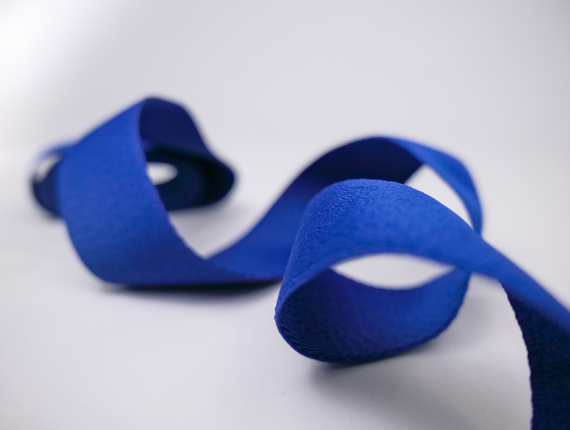
Polypropylene webbing is a technical textile webbing, woven or braided from a thermoplastic polyolefin with a density of around 0.90 g/cm³, the lowest of the materials commonly used in webbing.
This single parameter accounts for most of its characteristics: buoyancy, lightness for a given width, and a strength-to-weight ratio that remains suitable for moderate loads. Before specifying this material in a set of specifications, it is advisable to be familiar with its precise mechanical and thermal properties.
Structure et propriétés du polypropylène
Polypropylene (PP) belongs to the polyolefin family, just like polyethylene. Its semi-crystalline structure gives it a melting point of between 160 and 170°C depending on the grade (around 163°C for a standard homopolymer), which is significantly lower than that of polyester (around 250°C) or nylon (around 220°C). It is this factor that limits the recommended range of applications for a PP webbing.
Its moisture absorption is virtually zero. The polymer does not absorb water and is not affected by prolonged immersion, unlike a natural fibre such as cotton. Its chemical resistance to acids, bases and common solvents is also a recognised strength, which is useful whenever the webbing comes into contact with cleaning products or hydrocarbons.
The technical advantages of polypropylene webbing
- Low density (≈ 0.90 g/cm³): for the same width and thickness, PP webbing remains lighter than its polyester or polyamide equivalents. A decisive factor for equipment worn on the person or carried on board.
- Zero moisture absorption: no water absorption, no swelling, no mould growth. The material retains its dimensions in damp conditions.
- Good chemical resistance: adequate resistance to common solvents, acids and alkalis.
- Controlled production costs: PP remains one of the most cost-effective textile raw materials on the market, which has a direct impact on the price of the finished webbing.
The mechanical limits to be included in your specifications
Polypropylene’s low melting point makes it more susceptible than polyester or nylon to heat-generating friction and to any prolonged exposure to heat. Under continuous load, it is also more prone to creep: a gradual and irreversible elongation over time, which must be monitored in long-term static load applications.
Its UV resistance remains adequate, though it does not match that of polyester. Prolonged exposure to sunlight, without stabilising treatment, leads to degradation through photo-oxidation, which gradually weakens the fibres.
For intensive outdoor use or heavy loads, a polyester or polyamide strap will offer better long-term mechanical strength. For light to moderate loads, however, a polypropylene strap remains a suitable choice, both technically and economically.
Dimensions and manufacture of polypropylene straps
Eurosandow produces two ranges of polypropylene straps, the structure of which differs depending on the required mechanical properties.
The flat, elastic, braided strap combines a natural latex core, which ensures controlled elongation, with a braided polypropylene cover, which protects the core and sets the elastic limit. It is suitable for applications requiring tensioned retention (elastic fastening, return force). Available in widths of 10, 15, 20, 25, 30 and 50 mm.
The rigid flat webbing, woven from polypropylene and containing no elastic component, is designed for fixed securing and light lashing. It is available in widths of 10, 15, 20, 25, 30 and 40 mm.
The choice between these two structures depends primarily on the required mechanical function.
FLAT ELASTIC POLYPROPYLENE BRAIDED STRAP
| Dimensions | Catalogue reference |
| 10 mm polypropylene strap | 81710309 |
| 15 mm polypropylene strap | 81715109 |
| 20 mm polypropylene strap | 81720109 |
| 25 mm polypropylene strap | 81725009 |
| 30 mm polypropylene strap | 81730009 |
| 40 mm polypropylene strap | 81740009 |
| 50 mm polypropylene strap | 81750009 |
RIGID, FLAT, WOVEN POLYPROPYLENE STRAP
| Dimensions | Catalogue reference |
| 10 mm polypropylene strap | 81971009 |
| 15 mm polypropylene strap | 81971509 |
| 20 mm polypropylene strap | 81972009 |
| 25 mm polypropylene strap | 81972509 |
| 30 mm polypropylene strap | 81973009 |
| 40 mm polypropylene strap | 81974009 |
Depending on your requirements and specifications, our research department can design polypropylene straps that are perfectly suited to your specific applications.
Recommended applications for polypropylene webbing
Its low density, resistance to water and low cost make it a suitable material for technical furniture, sports and leisure equipment, or lightweight fastenings in indoor or damp environments.
It becomes less suitable when specifications require high mechanical strength under continuous load or permanent outdoor exposure: in such cases, polyester takes over.
Polypropylene or polyester: what’s the deciding factor?
The choice generally comes down to two factors. Density and cost favour polypropylene. Mechanical strength under load and UV resistance when used outdoors favour polyester. Our page ‘Webbing: which material to choose?’ provides a detailed comparison table of these two materials, as well as cotton, polyamide and Kevlar.