

The elastic strap combines a natural latex core with a braided or woven fabric cover, made of polyester or polypropylene depending on the specific model.
It is this core that gives the strap its ability to stretch when pulled and then return to its original length, unlike a rigid strap, which does not move.
Before specifying an elastic strap in a set of specifications, it is best to understand how this structure works, its elongation limits and the widths available depending on the cover material.
How does an elastic strap work?
An elastic strap is based on a seemingly simple principle: a natural latex core, which provides stretch and recovery, protected by a textile cover that withstands friction and determines the limit of mechanical strength. It is the cover – whether braided or woven – that determines wear resistance, UV resistance and performance in damp conditions, not the core itself.
Unless specific requirements are stipulated, an elastic strap must not be stretched beyond 75 per cent of its elongation. Beyond this threshold, the latex loses its ability to return to its original shape and the strap becomes permanently deformed. This is a guideline that must be observed from the design stage onwards.
The elastic strap can, in particular, meet the following needs:
- support
- fastening;
- restraint
- tensioning
- fold-down
- close
- adaptation to a moving component.
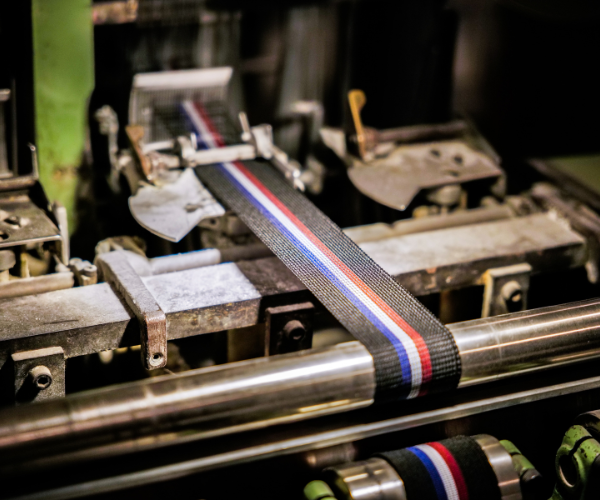
The elastic strap differs from a bungee cord or elastic cable in that it is flat. The choice between these different options depends primarily on the intended function and the project’s constraints.
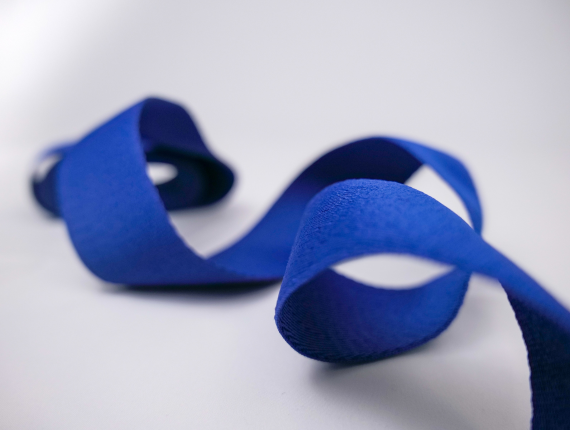
What is an elastic strap used for?
In an industrial project, the choice of a strap does not always start with a specific product in mind.
The need may, first and foremost, be functional: to support, hang, fold down or hold something in place.
An elastic strap can therefore be designed to fulfil various functions.
For example, it can be used to maintain tension whilst absorbing certain movements, to hold a component in place, to facilitate closure, or to secure a part without resorting to a completely rigid solution.
For example, in cars, the side straps in the boot are elasticated to hold items such as oil cans, cleaning products, etc.
The aim is not simply to choose a strap, but to determine the appropriate level of flexibility, strength and elasticity for the application.
Braided or woven elastic webbing: what’s the difference?
Eurosandow offers two covering techniques, each with its own distinctive appearance and application.
The braided elastic strap encases the latex core in a braided cover made of polyester or polypropylene. The braiding results in a denser strap with a slightly arched profile, suitable for repeated tensioning.
The woven elastic strap, available in polyester, is based on the same principle of a latex core with a flat-woven cover. The surface is softer, which slightly alters the feel and the way the strap lies against a surface.
The choice between the two depends mainly on the end use: the braided type withstands repeated cycles of tension better, whilst the woven type is suitable for applications where a flat, flexible profile is required.
Elastic polyester or polypropylene webbing?
The material used for the cover makes all the difference to how well it holds up over time, even though the elastic mechanism remains the same.
Polyester is more resistant to abrasion and UV light, making it suitable for outdoor use or applications involving frequent tension cycles.
Polypropylene is still lighter and cheaper, and is suitable for indoor use or applications subject to low stress.
Our pages on polyester webbing and polypropylene webbing set out the properties of each material, regardless of whether they are elastic or rigid in structure.
Available widths
Widths vary depending on the roofing material and the manufacturing technique.
| Structure | Material | Available widths |
| Braided elastic strap | Polypropylene | 10, 15, 20, 25, 30, 50 mm |
| Braided elastic strap | Polyester | 10, 15, 20, 25, 30, 40, 50 mm |
| Woven elastic strap | Polyester | 10, 15, 20, 25, 30, 35, 40 mm |
What other technical criteria should be taken into account?
Elasticity and tension
Not all applications require the same behaviour.
Depending on the role you are looking for, you should take the following into account:
- the required elasticity;
- the desired tension level ;
- the expected elongation;
- the behaviour of the strap once it is tensioned.
These factors are among the key criteria considered by technical buyers when assessing whether a product is suitable for their needs.
Strength
Strength is also a key criterion. Depending on the application, it may be necessary, in particular, to determine how the strap behaves under stress and to identify its breaking point.
The aim is to develop a solution that meets the actual demands encountered in its operating environment.

Manufacture of bespoke elastic straps by Eurosandow
In addition to the standard products listed above, Eurosandow also manufactures bespoke elastic straps at our production sites in France and Romania. Non-standard widths, specific colours, precise cut lengths, or special finishes or end fittings: our design department tailors the structure (braided or woven), the outer material (polyester or polypropylene) and the required elongation rate to your specifications, rather than limiting you to a fixed catalogue.
This custom manufacturing method is suitable for both small batches – to validate a prototype or a specific application – and for recurring industrial-scale production runs. One point to bear in mind remains the same as for standard production runs: beyond 75 per cent elongation, unless specific characteristics have been approved by our design office, the webbing loses its elastic recovery capacity. This constraint must therefore be addressed at an early stage, as soon as the requirements are defined.
For a customised design, please specify the width, length, preferred covering material and intended use (load, frequency of use, outdoor or indoor environment): these details enable our team to propose a suitable structure from the very first discussion.
Frequently Asked Questions
What is the maximum stretch of an elastic strap?
Unless otherwise specified, the elongation must not exceed 75 per cent of the initial length.
What width of elastic strap should I choose?
The most common widths range from 10 to 50 mm, depending on the material and manufacturing technique. The 20, 25 and 30 mm sizes are common to all three product ranges. Please specify the load and the required elongation for appropriate sizing.
Elastic polyester or polypropylene webbing – which should you choose?
Polyester offers better resistance to abrasion and UV light, which is an advantage for outdoor use or where the material is subjected to frequent tension cycles. Polypropylene remains lighter and more economical, and is sufficient for indoor use or applications involving minimal stress.